
Chattanooga is becoming one of the most important quantum technology hubs in the country. Through the Chattanooga Quantum Collaborative (CQC), a partnership between EPB, IonQ, local government, and major research universities, the city is building the infrastructure for quantum computing and quantum networking that could generate $5 billion in economic benefit over the next decade.
On the Spectruss Speakeasy Podcast, Chattanooga Quantum Collaborative CEO Charlie Brock breaks down what quantum technology is capable of, why Chattanooga is positioned to lead, and what this means for the city’s economy, workforce, and future.
What Is the Chattanooga Quantum Collaborative?
The Chattanooga Quantum Collaborative is a nonprofit organization focused on building a quantum ecosystem in Chattanooga, Hamilton County, and the broader Tennessee Valley region. CQC coordinates partnerships between local government, universities, private industry, and federal agencies to prepare the region for what quantum technology is about to make possible.
CQC’s 10-year goals are specific: $5 billion in economic benefit from quantum technology in Chattanooga and Hamilton County, and a quantum-ready workforce of 5,000 people. In May 2026, CQC launched the nation’s first quantum pre-apprenticeship program, a paid training designed to prepare professionals to lead quantum adoption inside their companies as the technology moves out of research labs and into commercial use.
Why Is EPB’s Infrastructure So Important for Quantum?
This part of the story starts in 2010, when EPB completed a 100% fiber optic network accessible to every customer in its service area. Chattanooga became the first city in the country with community-wide gigabit internet, and that decision generated nearly $2.8 billion in community benefit over its first decade.
EPB took the next step in 2022 by launching the nation’s first commercially available quantum network, EPB Quantum Network. Then, in April 2025, EPB’s board approved a partnership with IonQ (a global leader in quantum technology) to build the EPB Quantum Center. When it launches this year, it will be the first quantum technology center in the U.S. to provide commercial access to both quantum computing and quantum networking under one roof.
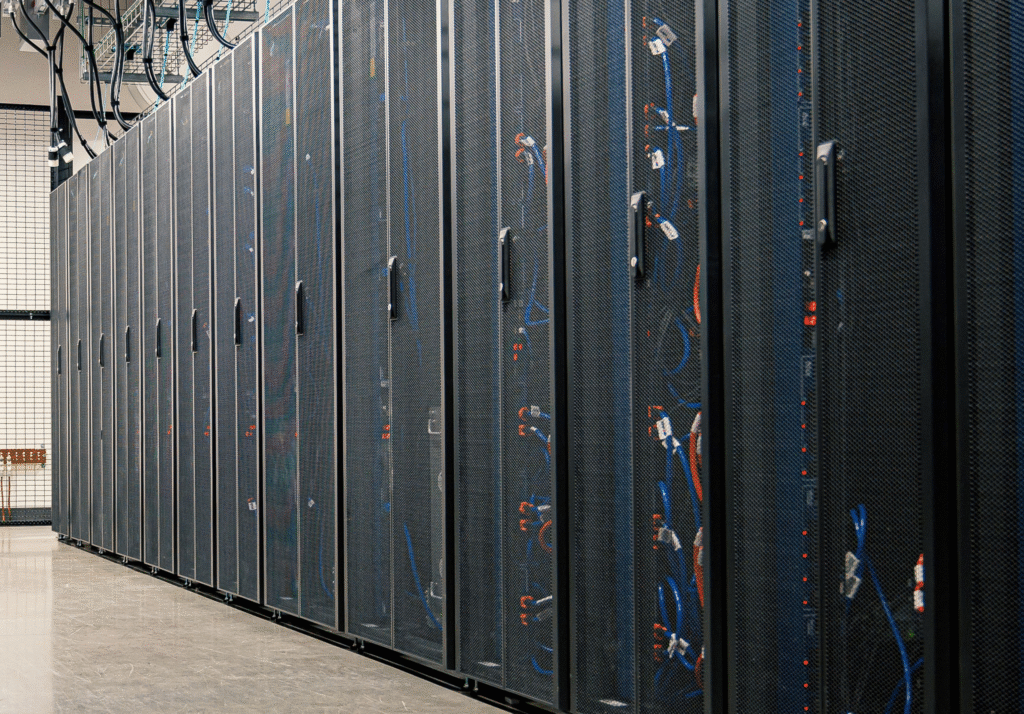
The IonQ Forte Enterprise quantum computer being installed at the EPB Quantum Center is a trapped-ion system. It does not need to be cooled to near absolute zero or require a football field of space to operate. It plugs into a standard wall socket and can fit inside a traditional data center environment. That accessibility is a big part of why this matters for commercial adoption.

How Many Quantum Computers Are in the United States Right Now?
It’s hard to pinpoint the exact number of fully functioning quantum computers, but Charlie Brock estimates that there are roughly 50 quantum computers operating in the U.S. today. What makes the Tennessee Valley stand out is concentration: soon, five of those machines will be located across Chattanooga, Huntsville, and Knoxville. Chattanooga sits right in the middle of that cluster, which raises a question Charlie digs into on the episode: what happens when we figure out how to connect those quantum computers to each other? That kind of regional density creates a network effect that benefits research institutions, commercial users, and the workforce pipeline all at once.
Vanderbilt University and EPB have also announced plans for a joint innovation institute in Chattanooga focused on accelerating quantum science and technology breakthroughs, further cementing the region’s position.
What Could Quantum Technology Mean for Chattanooga’s Economy?
CQC’s stated 10-year target is $5 billion in economic benefit for Chattanooga and Hamilton County. That figure accounts for direct jobs in quantum-related fields, the companies and research institutions drawn to the area by the infrastructure, and the downstream economic activity those create.
For context, EPB’s original fiber optic buildout generated $2.8 billion in community benefit over 10 years. Quantum represents a similar infrastructure bet, but with a longer time horizon and a potentially larger payoff. Quantum computing has applications in drug discovery, materials science, cryptography, logistics optimization, financial modeling, and energy systems. The healthcare applications alone (quantum-enhanced MRI, more precise disease detection, faster drug development) could bring new research dollars and medical technology companies into the region.
There is also the AI connection. As artificial intelligence continues to scale, its energy demands are growing fast. Quantum computing has the potential to dramatically reduce the computational resources required for certain AI workloads, which makes quantum infrastructure directly relevant to the AI economy.
What Does the Next Decade Look Like for Quantum in Chattanooga?
The pieces coming together right now in the Tennessee Valley are rare. You have a publicly owned utility (EPB) that already built and operates the fastest community-wide internet in the country. You have the first commercially available quantum network. You have a quantum computer arriving in 2026. You have a pre-apprenticeship program training workers. You have Vanderbilt partnering with EPB on a research institute. And you have a collaborative (CQC) with a clear 10-year plan, specific economic targets, and leadership from people who have built things in this city before.
One of the challenges Charlie talked about on the podcast is the networking piece. Individual quantum computers are powerful, but the real leap comes from learning how to connect them, how to network quantum machines the way we network classical computers today. That’s an unsolved problem, and Chattanooga is one of the few places in the country with the infrastructure to work on it commercially.
Charlie also made a point that stuck with us: culture matters more than technology when you are building something that lasts. Chattanooga has been here before. The fiber optic buildout worked because the community backed it. Quantum will require the same thing.
Who Is Charlie Brock?
Charlie Brock grew up inside one of Chattanooga’s legacy businesses. His family founded Brock Candy Company in the early 1900s, and it eventually became one of the largest candy manufacturers in the country. Charlie joined the company near the end of its run and was there when it went public, got acquired, and ultimately closed its Chattanooga operations. Watching that chapter close is what set everything else in motion.
From there, Brock co-founded Foxmark Media, a national mall advertising company that operated in more than 35 markets. After that, he turned his attention to building the infrastructure Chattanooga’s startup scene needed to exist. He co-founded the Chattanooga Renaissance Fund to back early-stage companies, ran CO.LAB as a startup accelerator, and served as CEO of LaunchTN for five years, helping build the state’s entrepreneurial support system from the ground up.
Now he’s leading The Chattanooga Quantum Collaborative (CQC), and the stakes are bigger than anything before it.
Frequently Asked Questions
What is the Chattanooga Quantum Collaborative?
CQC is a nonprofit focused on building a quantum ecosystem in the Chattanooga and Hamilton County region. It coordinates workforce training, industry partnerships, and infrastructure development around quantum technology.
What is EPB Quantum Center?
EPB Quantum Center is a partnership between EPB and IonQ. It will be the first facility in the U.S. to provide commercial access to both quantum computing and quantum networking in one location. The center is expected to launch in 2026.
Who is Charlie Brock?
Charlie Brock is a serial entrepreneur and the CEO of the Chattanooga Quantum Collaborative. His career spans venture capital, startup accelerators, and statewide economic development in Tennessee.
How does quantum technology relate to AI?
Quantum computing can reduce the computational and energy resources required for certain AI workloads. As AI systems scale, quantum infrastructure becomes a complementary technology that helps manage energy demand and processing power.
How many quantum computers are in the U.S.?
There are approximately 50 quantum computers in the U.S. today. Five will soon be located in the Tennessee Valley, across Chattanooga, Huntsville, and Knoxville.
What is the economic impact projection for quantum in Chattanooga?
CQC’s 10-year goal is $5 billion in economic benefit for Chattanooga and Hamilton County, along with a trained quantum-ready workforce of 5,000 people.
Where can I listen to the full Charlie Brock episode?
The full episode is available on YouTube, Apple Podcasts, Spotify, and iHeartRadio. You can also watch it embedded above on this page.